Precision Education is the Answer
The quest to explain, predict, and proactively intervene in students’ performance has been an arduous scientific topic for decades. Almost a hundred years ago, papers advocated using students’ behavior to predict their chemistry performance. More recently, we have mined learning management system data to develop early warning systems, sometimes explaining more than thirty percent of the variation in a student’s final grade. However, there is a fundamental flaw in how we conduct this research because we rely heavily on the average. Research is typically conducted by calculating the average across a sample of students to establish norms, representing the state of affairs for the group. While the average is an excellent statistical summary, it does not actually exist in real life.
Let us look at a few historical examples that prove this illusion. In 1907, Sir Francis Galton launched a competition asking people to guess the weight of an ox. The median guess of 1,207 pounds was remarkably close to the actual weight of 1,198 pounds, but not a single person was actually able to guess it right. In the 1930s, researchers created a statue named Norma based on the measurements of 15,000 women to find the perfect normal woman. When a contest was held to find the real-life Norma, the winner did not even match the measurements, and this eugenics experiment is the reason women’s clothing sizes remain so frustrating today. Similarly, in the 1940s, the US Air Force faced a daunting problem where planes crashed with no obvious mechanical dysfunction. The cockpits had been designed in 1926 based on the average measurements of hundreds of male pilots. A researcher named Gilbert S. Daniels measured 4,000 pilots across 140 dimensions and found that not a single person fitted the average on all ten key dimensions. This sparked a design revolution, moving away from a one-size-fits-all approach to adjustable, flexible designs.
Relying on group averages has led the scientific community into a reproducibility crisis. More than seventy percent of researchers have tried and failed to reproduce another scientist’s experiments. The core issue here is a lack of group-to-individual generalizability, which is a major threat to human subjects research. We often commit the ecological fallacy, assuming that what is true on average for a group must also be true for each person within that group. For the average of others to reflect your own reality, strict conditions like ergodicity and stationarity must be met. In reality, we are not interchangeable. Individuals differ substantially in their baseline levels, responses to interventions, and patterns of change over time. Sometimes, individual trends completely contradict group averages, as seen in Simpson’s paradox where an improving class average can completely mask an individual student’s decline.
You might think artificial intelligence is the solution to these problems, but if our state-of-the-art knowledge is deficient, AI will be too. Current AI models are trained on population-level, averaged data, which often fails to represent individual learners accurately. As a result, AI reproduces broad trends rather than generating genuinely novel, personalized insights. It cannot exceed the boundaries of its training data and lacks essential human interpretive abilities, such as reading body language or understanding the physical dynamics of a classroom. Because its training data is shaped by existing theoretical gaps and biases, AI would likely replicate and possibly amplify these biases, resulting in harmful outputs.
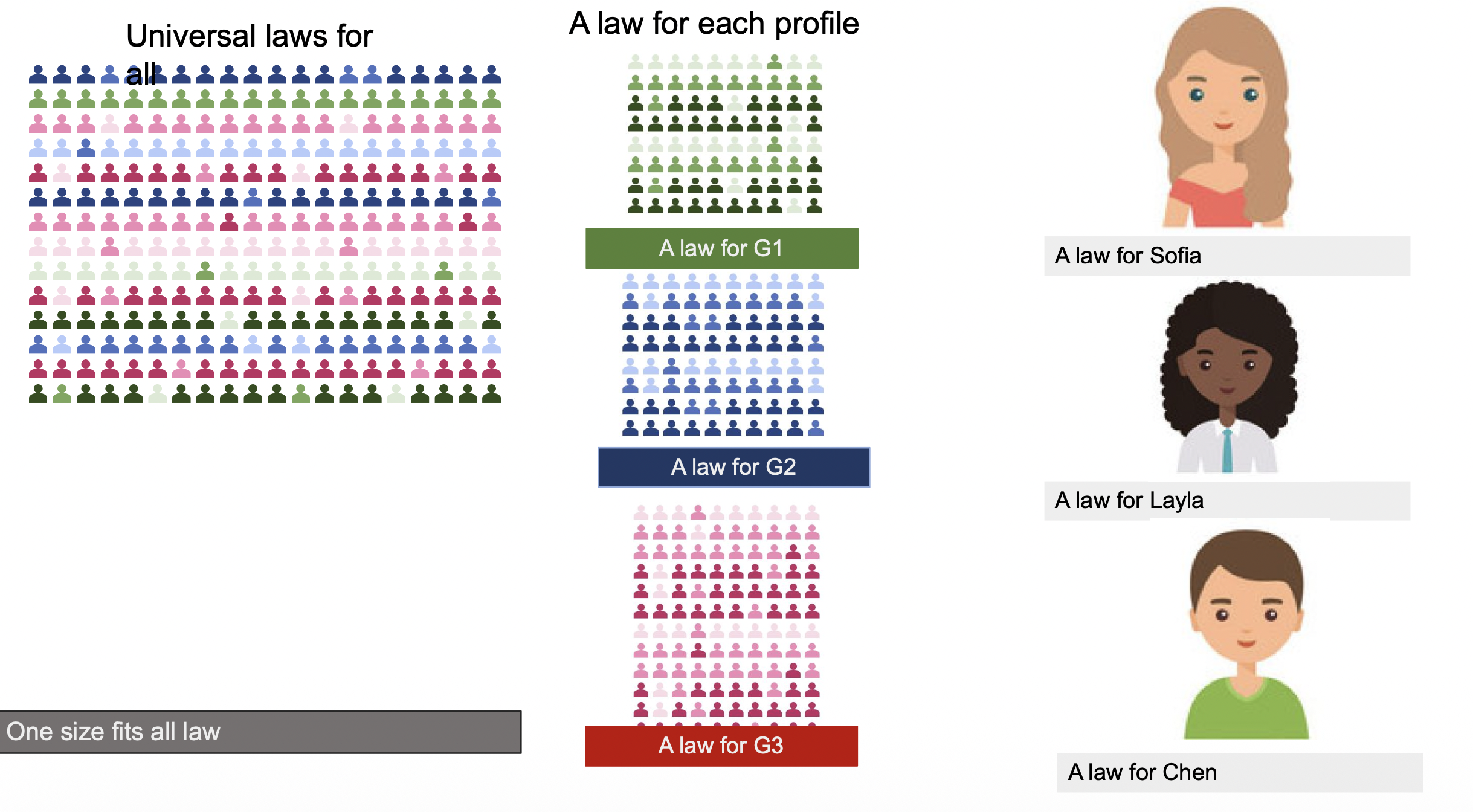
The real solution lies in precision education and idiographic research. Behavioral science is unlikely to change the world without a heterogeneity revolution. We must move from variable-centered approaches to person-specific approaches. Instead of a one-size-fits-all law, we need a law for each specific profile, or even better, a unique law for Sofia, a law for Layla, and a law for Chen. In our precision research, we treat individual students as whole units of analysis. We tracked 120 students over 40 days using ecological momentary assessment data twice a day, gathering over a million multimodal time points and thousands of survey responses. Using complex dynamic systems approaches, we mapped how students self-regulate on a deeply personal level.
References
Saqr, M. (2023). Modelling within-person idiographic variance could help explain and individualize learning. British Journal of Educational Technology, 54(5), 1077–1094. https://doi.org/10.1111/bjet.13309
Saqr, M., & López-Pernas, S. (2024). Mapping the self in self-regulation using complex dynamic systems approach. British Journal of Educational Technology, 55, 1376–1397. https://doi.org/10.1111/bjet.13452
Saqr, M., Cheng, R., López-Pernas, S., & Beck, E. D. (2024). Idiographic artificial intelligence to explain students’ self-regulation: Toward precision education. Learning and Individual Differences, 114, 102499. https://doi.org/10.1016/j.lindif.2024.102499
Saqr, M., Ito, H., & López-Pernas, S. (2026). Individualized Analytics: Within-Person and Idiographic Analysis. In M. Saqr & S. López-Pernas (Eds.), Advanced Learning Analytics Methods: AI, Precision and Complexity. Springer. https://lamethods.org/book2/chapters/ch18-idio/ch18-idio.html
López-Pernas, S., Kayaduman, H., Vogelsmeier, L.V.D.E., & Saqr, M. (2026). The three levels of analysis: Variable-centered, person-centered and person-specific analysis in education. In M. Saqr & S. López-Pernas (Eds.), Advanced Learning Analytics Methods: AI, Precision and Complexity. Springer. https://lamethods.org/book2/chapters/ch19-three-levels/ch19-three-levels.html